 Venn
Decisions over stored embeddings#
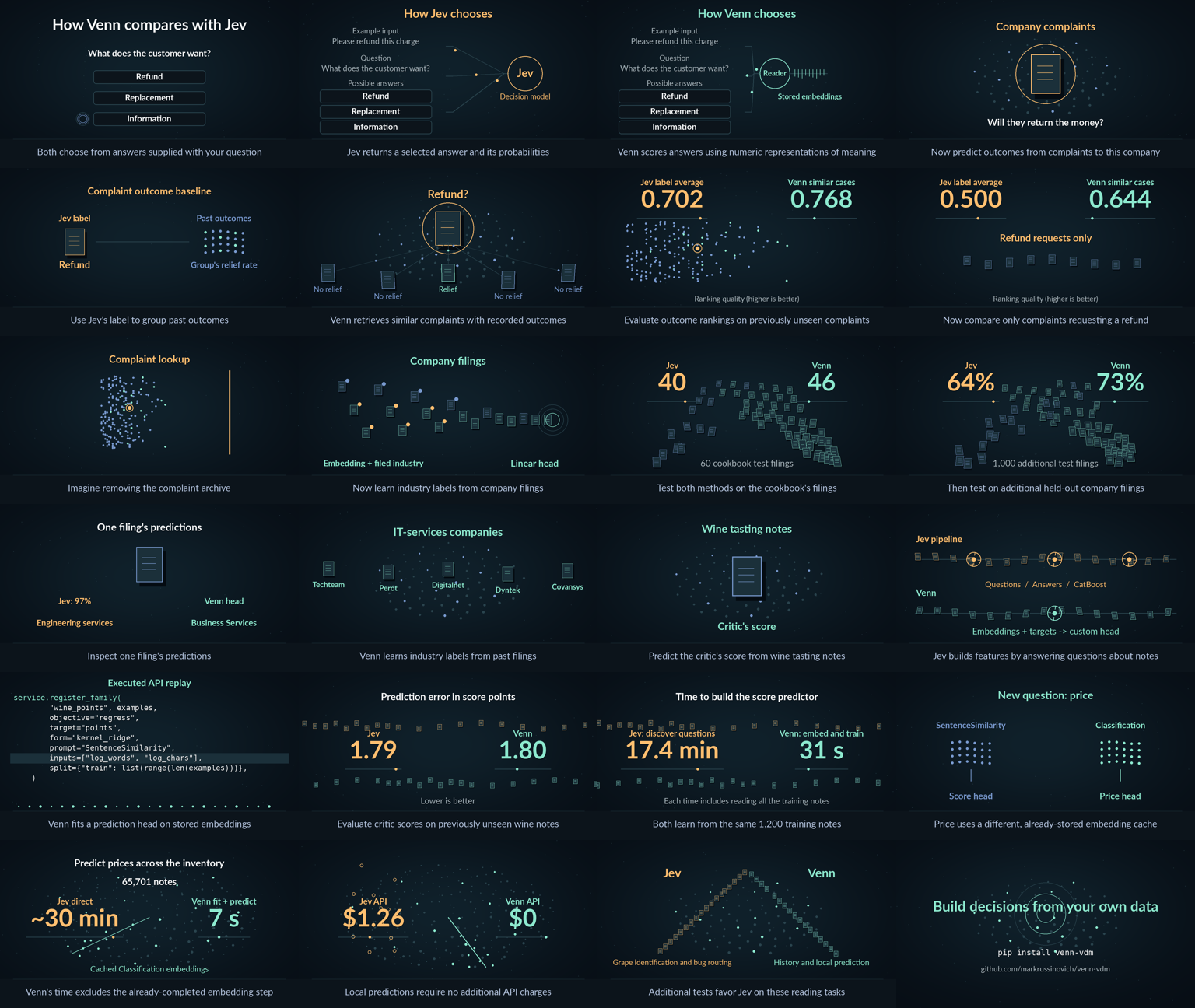
Private release preview, November 7, 2026. Clearances granted; public launch on hold. This companion to the screen-only arena video asks what business records remember about similar cases. It shows how historical outcomes, learned filing conventions and fitted predictors change what an application can answer. There is no narration.
Read the Venn and Jev guide for the project comparison. Jev supports text and images; it does not return embeddings or use embedding history. The text-only Jev scenes here show the inputs used in these examples.
What this video explains: how Venn differs from Jev, and why that matters. Jev is TypeSafe's decision model: supply an input, a typed question and possible answers, and it returns a selection with probabilities. This follows TypeSafe's System One description and Choice interface, not a generic chatbot diagram. Jev also supports images; the comparisons in this video use text, not all of Jev's input modalities. Venn encodes the input, question and choices and uses a small decision head to score the choices. It can work from stored embeddings: similar cases supply historical outcomes, labeled examples train task-specific heads, and cached vectors avoid repeating text-question pipelines. These are different information and execution paths, not a claim that one model wins every task.
Download landscape, 2:30 · English captions · Storyboard
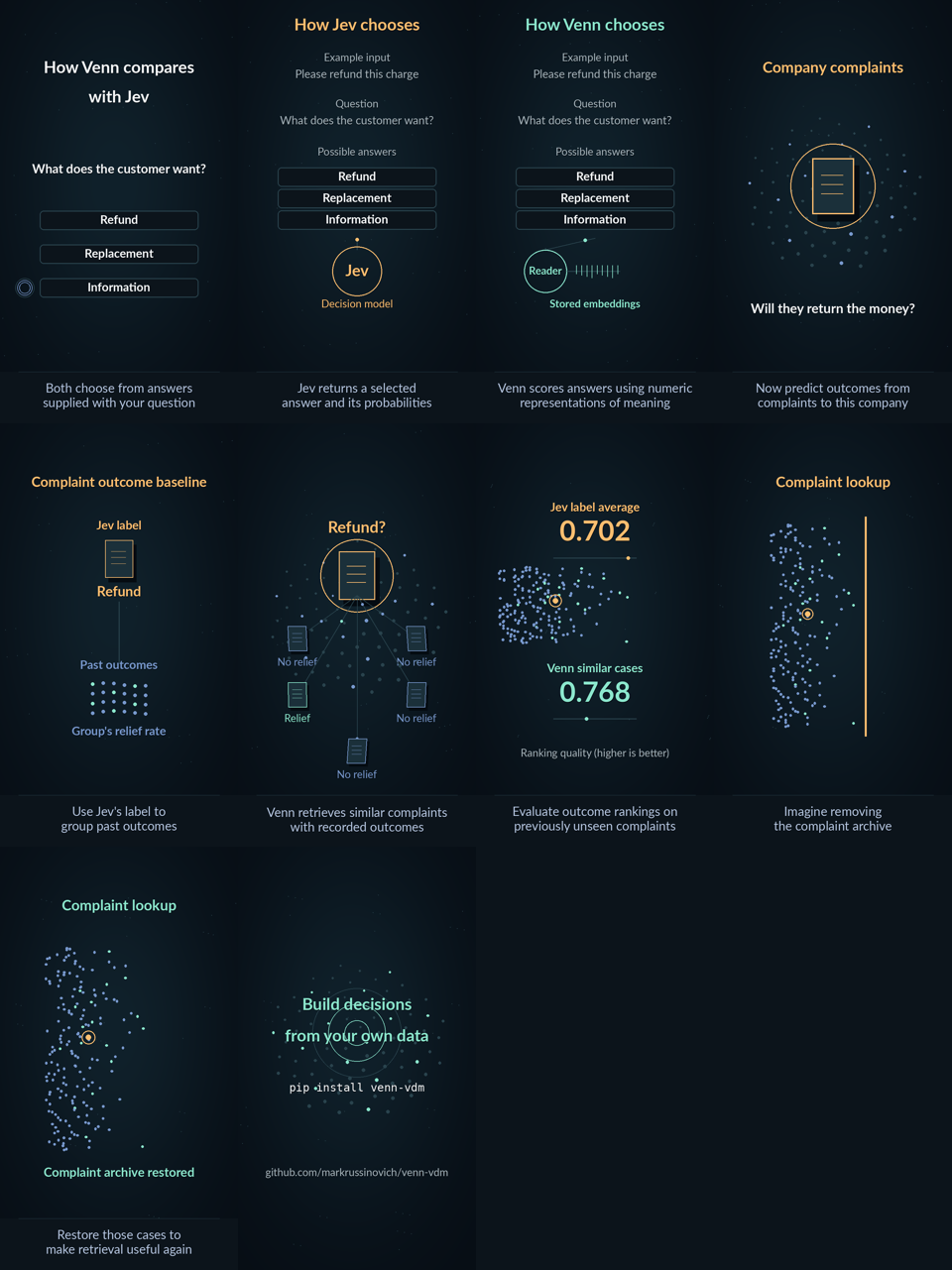
Download vertical, 1:00 · English captions · Storyboard · Provenance and edit manifest
The draft contains our own Jev measurements and answers. Publication warnings,
provisional disclosures, credits and technical qualifications live on this
page, not as fine print over the video. It is not the published-numbers-only fallback. No source
complaint narrative, tasting note or speech recording is played or printed.
The owner confirmed clearances on November 7 and authorized attaching both
cuts to the private repository's media-v1 release. The MP4s are now attached
there, with supporting files in Git. Repository visibility remains private;
public launch is still on hold. Release downloads require access to the private
repo until launch. The site builder uses local MP4s when available and the
release URLs otherwise.
What each beat references#
| Time | Demo and source | Check the video numbers | Run the related Venn interface |
|---|---|---|---|
| 0:00–0:24 | Setup, Jev's question-and-choice interface, then Venn's reader and head | Authored schematic, not a benchmark | Jev Choice, Venn concepts |
| 0:24–0:57 | History: MotherDuck's CFPB example and CFPB complaint data | History notebook, eval file | Outcome-store example, outcome API |
| 0:57–1:29 | Conventions: TypeSafe's classification-with-confidence cookbook | SEC notebook, eval file | Linear-family cookbook, family lifecycle example |
| 1:29–2:23 | Work: TypeSafe's wine feature-discovery cookbook | Wine notebook, eval file, executed registration | Runnable wine demo, kernel-ridge recipe |
| 2:23–2:30 | Scoreboard, limitations and close | Evidence, the beat notebooks and limitations below | Install, Precedent Desk |
These are related interfaces, not claims that the small synthetic examples
reproduce the research studies. The runnable wine demo defaults to the ridge baseline; select
--form kernel_ridge for the SentenceSimilarity-plus-length configuration.
It evaluates the cookbook's 800-note split, not the additional 3,000-note
comparison. The separate cookbook documents the registration call. No public end-to-end SEC or CFPB research runner
is implied by these links.
History: an outcome, not just a label#
The label-rate baseline applies MotherDuck's published method to a different population. It is not MotherDuck's own published AUROC, nor a direct Jev prediction of monetary relief. Jev assigns a requested-outcome label; the baseline returns the historical monetary-relief rate for that label. Venn returns the raw rate among similar same-company cases, with a product fallback when support is insufficient. Neither raw rates nor AUROC establish calibrated individual probabilities.
On the primary population, within-company AUROC is 0.702 versus 0.768. Among refund requests it is 0.500 versus 0.644. The test period is April 2023 through December 2024, 21 months excluded from the archive, with a 90-day gap. The primary and novel-stratum improvement gates passed. The eval file retains their recorded intervals and gate result; the notebook recomputes point estimates from anonymous company/label/score count histograms, preserving ties and company weights. Bootstrap intervals are not rerun by that notebook.
Example rule. The hero is the original pre-evaluation NIST-beacon draw, not a success selected for the video. The scatter shows 180 evenly spaced complaint IDs from that company's scored test complaints, plus the hero if absent. IDs, company identity and narratives are omitted from this export. Dot heights are layout positions, not another measured quantity. Colors show actual outcomes; the marked complaint received no monetary relief. Its five nearest displayed precedents include one relief outcome, but its prediction uses the full selected neighborhood, not just these five.
The wipe is explicitly conceptual. Dots collapse to a common line to illustrate loss of ranking evidence. No empty-store service result or measured 0.50 AUROC is claimed. A constant ranking would have 0.50 AUROC by construction where both classes exist; that does not prove the API returns a coin flip.
The opening uses the authored Choice example and makes no MotherDuck throughput claim. The video's "Ranking quality (higher is better)" is the within-company AUROC documented above, not the percentage of complaints correctly classified.
SEC: show the result and the failed gate#
On TypeSafe's 60 filings, the Jev rerun got 40 groups right and Venn's linear family 46. The one-sided paired p-value is 0.09: the primary accuracy gate failed, as did the useful-answer gate. On 1,000 additional, unfiltered filings, group accuracies were 64.1% and 73.3%. That confirmation is report-only under the original protocol, not a replacement passing gate. This page retains both facts; the video does not list SEC as a demonstrated win. The cookbook's own published Jev result was 39/60.
Example rule. Filing 23082_2004 was specified editorially in the brief;
it was not randomly drawn. The cached SEC company lookup identifies it as
COMPUTER SCIENCES CORP, SIC 7373. Jev selected engineering services with
97% confidence; Venn selected the filed Business Services group. The retrieved
neighbors are Techteam Global, Perot Systems, Digitalnet Holdings, Dyntek and
Covansys, all in group 73. Their names are metadata, not reproduced filing text.
This strip illustrates retrieval from the same archive. It is not a causal explanation of the linear head's prediction. Training labels explicitly supply the filing convention, so the draft does not say "Nobody told Venn." The division breakdown was post hoc; the retail/wholesale observation is not promoted to a separately tested general claim.
Wine: accuracy and work are separate measurements#
Revision 2 passed G1, not G2. On 3,000 fresh notes, Venn scored 1.803 RMSE versus our five-round pipeline rerun's 1.794, inside the predefined 2% point-estimate rule. The ratio's 90% interval was 0.983–1.026; G1 is not an equivalence confidence-interval test. G2's equivalence interval on the 800-note second look was too wide and failed. Revision 1's failed results are not overwritten.
On screen, these results are labeled "Prediction error in score points", with 1.79 for Jev and 1.80 for Venn and an explicit "Lower is better". The underlying measure is root mean squared error, rounded to two decimals; it is not mean absolute error. The acronym remains in the notebook and methods, not in the video.
The 31-second Venn build includes embedding 1,200 fitting notes and family selection/fitting on one A100. The 17.4-minute Jev comparison is a separate live five-round discovery run that ended with 35 questions; it is not a timing of the published 38-question pipeline. This page identifies it as a separate historical run. These figures are not a controlled hardware-only speed comparison.
The timing card is headed "Build a score predictor", with the fitting-note count scoped to Venn and an explicit embedding-included caption. The later "Predict prices across the inventory" card describes a different job, shows the inventory size and says Venn's time excludes the already-completed embedding step. These are not consecutive stages of one benchmark.
The published-numbers-only alternative is Venn 1.765 versus TypeSafe's published 1.772 on 800 notes, labeled as a second look. It omits our Jev rerun figures and timings; it was prepared while they awaited clearance. The owner cleared them for publication on November 6, 2026.
New question: price. On all 65,701 notes, with embeddings already stored, the Venn regression family took 3.29 seconds to train and 3.57 to predict, about 7 seconds combined, with no API charge. This is not zero local compute cost. Embedding the whole file was a separate, once-paid 76-second A100 pass.
Vector reuse qualification. Price uses Phase 14c's already-cached Classification-prompt vectors. The winning revision-2 score head uses SentenceSimilarity-prompt vectors plus length features. These are not the same vector cache. This transition demonstrates another question on stored vectors, not a measured price head on the winning score head's exact vectors. This page identifies the price prompt explicitly; a literal same-vectors cut would need an additional evaluation, not an assumption.
Jev direct took approximately 30 minutes and $1.26 for price. The timing is scaled from the final measured portion after a credit interruption; all answer costs are summed. Two endpoint passes ran concurrently, so observed latency includes shared capacity. The fresh price pipeline adds discovery and took about 53 minutes, around $13; the roughly 1.5-hour figure applies to the fresh variety pipeline, not price.
Price accuracy was tested on held-out notes, not the whole inventory: Venn's log-price RMSE was 0.538 versus 0.531 for the Jev arm selected on dev. The paired 90% interval was inside the predefined equivalence margin. The inventory sweep measures work; it does not create another accuracy test. The draft replaces the old 145-second/9-second comparison with these measured whole-file timings, excluding embedding on Venn's new-question path.
Archived assets and source credits#
The removed audio beat's notebook and eval file remain as provenance for earlier drafts. They are not loaded by the current renderer or represented in either cut's results. Their historical results and example-selection rule are unchanged.
Credit and rights. CREMA-D: Cao, Cooper, Keutmann, Gur, Nenkova and Verma (2014), source and license information, ODbL 1.0 and DbCL 1.0. The exported waveform envelopes are derived CREMA-D database contents and retain those terms; they are not covered by the repository's code license. No intelligible speech audio is included. Playback clearance, or replacement recordings from consenting speakers, is still needed for a spoken version.
Wine data is credited to Wine Enthusiast via the pinned GroNLP winemag dataset (CC BY-SA 4.0 as declared there). No tasting notes are redistributed here.
Scoreboard and claim limits#
Jev wins the recorded grape-identification comparison and described-queue bug routing comparison; Venn's history does not universally beat reading the item. The scoreboard cites those failures without adding unmeasured "brand-new categories" or post-hoc division claims. History-based outcome ranking, price with less work are the positive cases. SEC remains inconclusive at its original gate. "Same typed questions" describes interface and task families, not identical information available to both systems or proof that a Jev application cannot also use an external archive.
The close invites the viewer to build decisions from their own data. It does not add a blanket superiority claim. Jev and TypeSafe are named in text, not logos or the poster.
Recompose and verify#
See the renderer and notebook instructions. The three active notebooks recompute point estimates from curated numeric exports. They do not rerun the original experiments, remeasure timings, independently verify bootstrap intervals or resolve publication rights. The manifest hashes the exact exported eval files and both MP4s. Narratives, raw vectors, model checkpoints, API credentials and original experiment archives are not included.
All text is safe-area and overlap checked by the renderer; story captions have at most
eight words and frames at most three numeric values. No rendered text is
smaller than 48 pixels at the final 1080-wide/high output scale. Animated records are
schematic; scatter positions use recorded scores.
The workflow lanes are diagrams. The separate code replay shows the exact
register_family call inside head_demo.py's register_head, including
the kernel-ridge form, embedding prompt, length features and fitting split.
That function was executed on the original 1,200 fitting notes using the
already-cached SentenceSimilarity vectors; the reader was not run again.
The selected settings matched the archived run. This execution is not a new
held-out result or a substitute for the historical embedding-inclusive build
time. Its code hash and head checksum are recorded in the execution export.
Music and synchronized effects are original deterministic synthesis.
Release checklist#
- [x] Owner confirmed clearances for the current review draft on November 7.
- [x] Attach both approved MP4s to the private
media-v1release. - [ ] Wait for the public launch instruction before changing visibility or deploying Pages.
- Resolve source-material rights before adding complaint narratives, wine notes or speech playback. The current draft withholds all three.
- Measure the CFPB wipe before replacing the explicitly conceptual wipe with an empirical claim.
- Publish end-to-end notebooks and required source access before saying every experiment can be independently rerun.
- Confirm option-label mapping, vote-path speed, vector-format versioning and CPU documentation requirements before calling the full brief complete.
The kernel-ridge feature landed in 1affa58; the Windows solver fix and its
test correction are in 43b69aa and 0227868. The latter's
CI run
passed, including Windows ARM64 and Linux ARM64. That engineering issue is
resolved; publication remains a separate owner decision.
Production notes#
These notes describe how the recorded evidence was edited into the video.
Reading-time revision. The audio beat is removed from both cuts, including its scoreboard and closing claims. Its 20 landscape seconds and 16 portrait seconds now give the existing architecture, complaint examples, filing labels, pipeline, code and embedding-cache explanations more reading time. Total durations are 2:30 and 1:00. A later four-second trim removes the summary animation and shortens the end card, preserving the slower explanations. Architecture reveals are spread over eight seconds; the verbatim code highlight makes one ten-second pass followed by a four-second settled view. The filing gallery introduces companies individually, then connects them to their recorded Business Services label.
Opening revision. The first screen sets up a comparison of how Jev and Venn choose among supplied answers. Jev's architecture appears first, followed by Venn's on a separate screen with the identical input, question and options. The Venn diagram introduces the reader, stored embeddings and decision head. Input, question, choices and processing stages appear in sequence, with a focus marker and moving signals guiding the eye through the diagram. The diagrams never share a frame.
The opening uses an authored example: "Please refund this charge", the question "What does the customer want?", and Refund, Replacement and Information as options. The highlighted Refund choice is an illustration of the selection contract, not an API response, held-out example or new measurement. It is separate from the preselected research complaint shown in the history beat. Jev can evaluate several questions in parallel; the animation does not imply one serial language-generation pass per question.
Narrative bridges. The next question changes from classifying the request to predicting monetary relief. A grouping schematic first explains the Jev-label baseline; its dots illustrate the method, not individual research records. The real precedent strip and held-out comparisons follow. The wipe is explicitly a hypothetical removal of this complaint lookup archive, not erasure of a trained head. The vertical cut restores that archive before closing. SEC then introduces a new dataset and fitting a linear head before its two separately labeled test sets. The company gallery illustrates a filing convention, not the causal explanation of that head's prediction.
Wine notes and the critic-score question precede the pipelines. Accuracy, separate historical preparation runs and the new price question have distinct setups. The price bridge shows both embedding caches rather than implying that the score and price heads used identical vectors. The scoreboard identifies the grape and bug-routing comparisons as additional tests.
Explanatory captions occupy one reserved area, with regular-weight cool-blue text distinct from the graphic labels and no sentence-ending periods. Related title lines use the same font and color, and the extra explanation beneath the architecture is removed. Answer choices are stacked with padding in both cuts. Every rendered frame checks text overlap, answer-box and node containment, metric-column bounds and separation from the narration area. The players keep optional caption tracks off by default to avoid repeating the captions already drawn into the video. The former SEC verdict card is removed. The SEC gate results remain documented below; removing an editorial card does not turn a failed gate into a passing one.
The edit was rebuilt after inspecting half-second sequences from the actual encoded Doom video, not just its storyboard. Doom leads with observable action, then briefly exposes the mechanism behind it. After the technical introduction, this cut follows one marked request, the archive coming alive around it, retrieved cases flying into view, and the wipe interrupting that flow. SEC filings sort in motion, the wine workflows keep processing behind their measurements. There are no slide panels, persistent headers, watermarks or fine-print footers. Short, large captions carry the story.
Every frame is animated at 30 fps, rather than animating a card's entrance and then holding it still. Hard cuts keep adjacent shots' labels and numbers from overlapping. The music now has an original rhythmic synth score with edit impacts and retrieval ticks, including a drop during the wipe. These are authored motion graphics using the recorded results, not live application footage or real-time processing clocks. Animation speeds are editorial; no performance measurement is inferred from them. The code beat displays the verbatim registration function that was actually executed, with execution provenance. Its replay is compressed to fit the edit; it has no real-time stopwatch.